
The Value of the Old Testament in New Testament Preaching and Teaching
- Dr. Wes Moore
.jpg/v1/fill/w_320,h_320/file.jpg)
- Dec 13, 2025
- 20 min read
Updated: Jan 10

“We are New Testament believers,” someone says. “The Old Testament is secondary for us.” This attitude is common today, especially among preachers and teachers.
The idea is that, since Jesus has come and the New Covenant has been inaugurated, the truths found in the Old Testament are largely unnecessary for the modern believer. Therefore, it’s best just to focus on the New Testament.
Even those who would not say this openly make their convictions clear through their actions. How? By preaching and teaching almost exclusively from the New Testament. Week after week goes by, and the Old Testament never makes an appearance.

Is the underlying assumption correct, however? Does the coming of Christ and the institution of the New Covenant mean the Old Testament is no longer of any value?
The short answer is no. The Old Testament continues to be of profound significance and should be a regular part of the spiritual diet of all believers.
This article will support this claim by doing the following:
Explain the relationship between the Old and New Covenants.
Present New Testament teaching on the value of the Old Testament.
Outline seven enduring benefits of Old Testament truth.
Provide recommendations for using the Old Testament in teaching and preaching.
Download a printable pdf of this article:
The Relationship Between the Old and New Testaments
Let’s begin by clarifying some terms. The Old Testament portion of the Christian Bible contains writings related to the Old Covenant. A covenant refers to a binding agreement made between two parties, in this case, between God and his people before Christ.
(The word “testament” comes from the Latin word testamentum, which essentially means “covenant.”)
The New Testament contains the documents specifying the New Covenant, the agreement between God and his people after the death and resurrection of Christ.
The “Old” Covenant is only old in the sense that it is the one made before Christ; the “New” Covenant is only new in the sense that it followed the prior one.

The Old and New Covenants—Similarities and Differences
The two covenants have important elements in common. They both have the same God, the God of Abraham, Isaac, and Jacob (whom we call the God of the Bible). They also have the same purpose, namely, the redemption of human beings.
These similarities are overshadowed by their critical differences, however. In general, they diverge on two fronts: the means by which redemption is accomplished and the individuals to which redemption applies (its scope). Let’s discuss these briefly now.
Similarities and Differences Between the Old and New Covenants
Similarities | Differences |
|---|---|
Both have the same God, the God of Abraham, Isaac, and Jacob | The means by which redemption is accomplished |
Both have the same purpose, redemption | The individuals to which redemption applies |
Under the Old Covenant, the means of redemption was obedience to a set of laws given by God following the Exodus of the Israelites from Egypt, a law known as the Law of Moses.
Under the New Covenant, the means of redemption is faith in the Redeemer, Jesus Christ, who obeys those laws in place of the individual and offers himself as a payment for that individual’s sins.
Where scope is concerned, under the Old Covenant, the redeemed primarily came from the physical descendants of Isaac, whose name God changed to Israel.
In the New, any person who places his faith in Christ’s work—regardless of whether he is physically related to Israel or not—and, through faith, commits to follow and serve him, is included in the covenant.
Differences Enumerated
Comparative Element | Old Covenant | New Covenant |
|---|---|---|
Means of Redemption | An individual's obedience to the Law of Moses | Faith in the Redeemer's (Christ's) work on the individual's behalf |
Scope of Redemption | The physical descendants of Isaac (Israel) | Anyone who trusts in Christ’s work, regardless of physical relationship to Israel |
Following the completed work of Christ, the laws governing the Old Covenant were withdrawn, being fulfilled by Christ himself.
The New Covenant establishes new laws, which are not equal to those of the Old. In some cases, Old Covenant commandments are reinstituted in the New, but in many others, they are not.
What does this mean for the relationship between the Old and New Testaments? It means the portions of the Old Testament that specify the laws given to Moses no longer apply and are not binding for believers today.
Does this mean the entire Old Testament is null and void? No, because the Old Testament includes much more than the Law.
A Closer Look at the Mosaic Law and the Body of Old Testament Truth
In broad terms, the Law of Moses dealt with three types of commands—moral, ceremonial, and cultural.
Moral laws had to do with right and wrong. An example would be the commandment, “You shall not murder” from the Ten Commandments (Exodus 20:13).
Ceremonial laws had to do with the sacrificial system and the various religious events on the Jewish calendar. Rules about the dress and activity of priests fit into this category (Leviticus 6-7), as well as specifics about feasts like Passover (Deuteronomy 16).
Cultural laws were those that made God’s people unique from a social standpoint. Laws regarding forbidden foods, circumcision, and clothing fall into this category (Leviticus 11, 12, and 19).
When the New Covenant was instituted, all of these categories, and each of the commands they presented, became obsolete (see Romans 7:4-6 and Ephesians 2:15, for example).
Therefore, the specific portions of the Old Testament containing them—like parts of Exodus, Numbers, and Deuteronomy, and all of Leviticus—are obsolete as well.
This is not to say there is nothing we can learn from these laws or books; they reveal much about God’s nature and character. But for the purposes of living a life to please God, they are irrelevant.
What we must realize, however, is that the Old Testament contains much more than a list of laws given to Moses. These are central, yes, but they do not constitute the entirety of the truth God revealed during the Old Covenant period.
Much of what it sets forth is relevant today, even though many portions have been replaced by New Testament teaching.
The New Testament on the Value of the Old Testament
Before we get into the specific benefits the Old Testament offers, let’s consider the New Testament perspective. What does it say about the ongoing value of this part of the Bible? We’ll begin with Paul.

Paul Affirms the Value of the Old Testament
The apostle Paul directly affirms the ongoing value of the Old Testament in at least two places. First, there is 2 Timothy 3:16, which reads, “All Scripture is given by inspiration of God, and is profitable for doctrine, for reproof, for correction, for instruction in righteousness.”
Some might be wondering why I chose this text to discuss the value of the Old Testament, given its almost universal association with the doctrine of inspiration. The answer can be found in the first words.
Notice the verse says, “All Scripture.” Not part of Scripture but all. Now, do we believe Paul meant just the New Testament when he said this? There’s no way he could have.
One, he used the Old Testament extensively in his own writings, and two, roughly a third of the New Testament had not been written when he penned these words.
Paul clearly meant the Old Testament as well as the New when he referred to “all” of Scripture.

And what does it say all Scripture is relative to the man of God? “Profitable.” The word means “to be advantageous.” And what is it advantageous for? “For doctrine, for reproof, for correction, [and] for instruction in righteousness.”
So, according to Paul, not only is the New Testament profitable for accomplishing these things, but so is the Old.[1]
He is even more pointed in Romans 15:4. There, he says, “For whatever things were written before were written for our learning, that we through the patience and comfort of the Scriptures might have hope.”
The phrase “whatever things were written before” refers specifically to Psalm 69, which he had just quoted in verse 3; it also refers to the entire Old Testament, because he connects the phrase to “the Scriptures” (as in, all of the Scriptures) at the end of the verse.
Paul's Direct Validation of the Old Testament
Verse | Text |
|---|---|
2 Timothy 3:16 | “All Scripture is given by inspiration of God, and is profitable for doctrine, for reproof, for correction, for instruction in righteousness.” |
Romans 15:4 | “For whatever things were written before were written for our learning, that we through the patience and comfort of the Scriptures might have hope.” |
Notice too he says these prior truths were written “for our learning.” God, in his unsearchable wisdom, recorded and preserved the Old Testament, not just for the edification of Old Covenant believers, but also for the edification of New Covenant believers.
Let me quote two excellent commentators on the high view of the Old Testament Paul presents in this text. John Murray, in his combined volumes on Romans, put it this way:[2]
The extent to which Paul’s thought was governed by this truth [that the Old Testament was written for our learning] is evident from the frequency of appeal to Scripture in this epistle.
The form of statement here…shows that in Paul’s esteem Scripture in all its parts is for our instruction, that the Old Testament was designed to furnish us in these last days with the instruction necessary for the fulfillment of our vocation to the end. [emphasis added]
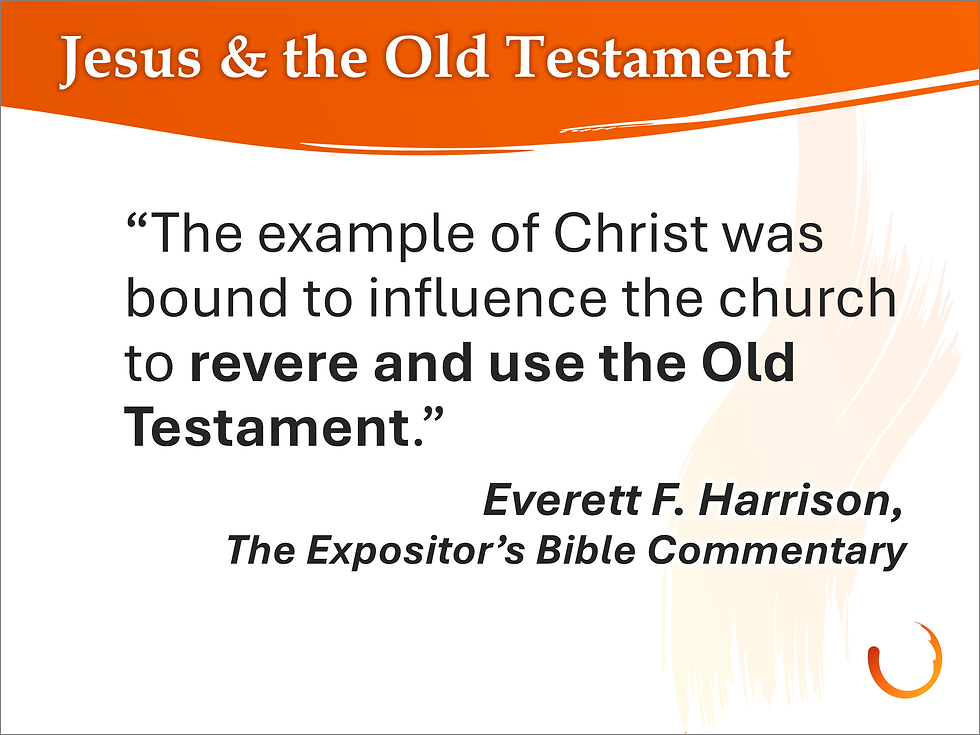
Everett F. Harrison, in his analysis of this text in The Expositor’s Bible Commentary adds:[3]
Having cited Psalm 69, the apostle is led to refer to the Scriptures in a more general way as useful for the instruction of New Testament believers—in fact, as deliberately planned for their edification.
The very phenomenon of quoting from the Old Testament speaks loudly of the dependence of the church on the course of redemption history reflected there.
Things both new and old enter into Christian faith the example of Christ was bound to influence the church to revere and use the Old Testament. [emphasis added]
Notice the terms they use in making their points. Paul “esteemed” the Old Testament and found it “useful,” and the Old Testament was “designed” and “deliberately planned” to benefit New Covenant believers.
It is therefore necessary for the “fulfillment of our vocation” and should cause us to “revere and use” the Old Testament today.
Paul puts his money where his mouth is in 1 Corinthians 10. In the first 13 verses, he cites example after example of the judgment Old Testament believers experienced because of their rebellion.
It is important to note that every example he used here came from Exodus and Numbers, books contained within the Law. So, here we have Paul specifically drawing lessons from the Law to instruct New Covenant believers.[4]
He does so to warn Christians about committing the same sins and suffering the same fate. He uses the phrase “nor let us” multiple times to discourage us from repeating their mistakes.

In verses 6 and 11, he says these accounts were not just historical records meant for ancient believers; they are “our examples…written for our admonition, upon whom the ends of the ages have come.”
“Admonition” is from the Greek nouthesía, which means to educate in order to alter a person’s will and actions.
The Other Apostles Applying Old Testament Truth
Other New Testament writers applied the Old Testament in a similar fashion. Consider a few examples:
Peter: Peter uses Noah’s flood, Sodom and Gomorrah, and Lot to illustrate the truth that “the Lord knows how to deliver the godly out of temptations and to reserve the unjust under punishment for the day of judgment” (2 Peter 2:4-9). He returns to Noah in the next chapter to warn scoffers about doubting the Day of the Lord (2 Peter 3:5-7).
James: James mentions the Old Testament prophets and Job as examples of endurance and evidence of the Lord’s mercy and compassion (James 5:10-11). He also uses Abraham and Rahab to prove the need for good works to follow genuine faith (James 2:21-26).
The Author of Hebrews: The author of Hebrews references the judgment of 40 years in the wilderness to encourage Jewish believers to maintain their faith in Christ and avoid the “evil heart of unbelief” that plagued the Israelites (Hebrews 3:7-19). He then provides examples of Old Testament figures who accomplished great things through faith, including Abel, Noah, Abraham, Jacob, Sarah, Joseph, and Moses (Hebrews 11).
Jude: Jude notes the unbelief that followed the Exodus and the judgment the Israelites suffered as a result (5), as well as the sin of fallen angels (6), Sodom and Gomorrah (7), Cain, Balaam, and Korah (11).

Jesus and the Value of the Old Testament
The Lord Jesus used the Old Testament to teach and warn, as well.[5] Here are a few examples:
Matthew 11:20-24 – Sodom as reference point for the punishment due Capernaum for rejecting him as the Christ.
Matthew 12:1-8 – David’s actions in 1 Samuel 21 to make a point about the Sabbath.
Matthew 12:39-41 – The response of Ninevah after Jonah’s preaching as a witness against the Pharisees for rejecting him as the Christ.
Luke 4:25-27 – Zarephath and Naaman from 1 Kings 17 and 2 Kings 5 as examples of God’s mercy on Gentiles.
Luke 17:26-32 – Noah and Lot as illustrations of his Second Coming.
Now that we’ve seen the high regard in which the New Testament holds the Old, let’s outline specific benefits the Old Testament affords contemporary Bible teachers and preachers.
Jesus & the Apostles Applying Old Testament Truth
Jesus | The Apostles |
|---|---|
Matthew 11:20-24 – Sodom | Paul: 1 Corinthians 10 – Old Testament Judgments |
Matthew 12:1-8 – David’s actions | Peter: 2 Peter 2 & 3 – Noah’s flood, Sodom and Gomorrah, and Lot |
Matthew 12:39-41 – The response of Ninevah | James: James 2 & 5 – Old Testament prophets, Job, Abraham, and Rahab |
Luke 4:25-27 – Zarephath and Naaman | Author of Hebrews: Hebrews 3 & 11 – 40 Year Wandering, Abel, Noah, Abraham, Jacob, Sarah, Joseph, and Moses |
Luke 17:26-32 – Noah and Lot | Jude: Jude 1:5-7, 11 – Exodus, fallen angels, Sodom and Gomorrah, Cain, Balaam, and Korah |
Seven Enduring Benefits of Old Testament Truth
1) The Creation of the World
Genesis 1-2 answers questions regarding who made the world, when, and why. It specifies God’s creative acts in sequence, as well as the forming of time, space, and matter.
Moreover, it covers man’s supremacy in God’s created order; the nature and importance of marriage; gender categories and roles; and the entrance of death and suffering into the world.
These truths are critical for many reasons. Among other things, they give people a sense of purpose and meaning. Human beings are not accidents of time and chance, with no value beyond the few short years they live on the earth.
Moreover, they provide the ammunition needed to refute the destructive doctrine of evolution, which argues there is no God, no right or wrong, and no ultimate value to life.
2) Significant Historical Events
The Old Testament accurately records some of the most important events in human history.
Not only does it detail the creation of all things (covered previously), but it also explains the origins of the nations (the Tower of Babel), the global judgment that reshaped the geology of earth (the Worldwide Flood of Noah), and key historical facts about ancient civilizations (Egypt, Assyria, and Babylon, to name a few).

This is beneficial for a number of reasons:
It explains why people have different languages and are separated into different groups around the globe
It links people to a common bloodline, uniting the human race as one family
It provides a framework for understanding what we see in the natural world, like animal distributions, rock layers, and fossils
It supplies reliable anchor points for the study of human history.
All these truths stand against the lies men and angels attempt to tell people about their history, lies used to manipulate and destroy them.
3) God’s Nature, Attributes, and Ways
The Old Testament offers countless details and examples that reveal who God is, what he is like, and how he interacts with human beings. It demonstrates how unbelievably powerful he is, that he is a covenant-making/covenant-keeping being, and that he is moral and just.
Furthermore, it shows his patience, forbearance, mercy, and willingness to forgive. And lastly, it explains his relationship to human suffering and how he uses it to accomplish his ends.
This proves helpful in a variety of ways.
Knowledge of God: It allows us to know God on a deeper level, to see him in action in various situations, and to worship him for his perfections
Relationship with God: It gives us a sense of how to relate to him, how to please him, and what to expect when we fail him
Human Suffering: It also provides great insight into one of the most perplexing aspects of human life—suffering. Why do we suffer? What role does God play in it?
All of these and more are addressed in the Old Testament.
4) The History and Development of Redemption
As New Testament believers, we want to be “all about the gospel.” But the gospel would mean nothing if we did not have the Old Testament to give it context and meaning.
There, we learn why it was necessary in the first place (the fall of man), how God unfolded his plan to redeem humanity (through the Abrahamic Covenant, the Law of Moses, and the sacrificial system), and how the Israelites rebelled, leading to their destruction and the promise of a New Covenant.
The 7 Enduring Benefits of the Old Testament
Benefit | Description |
|---|---|
1) The Creation of the World | Answers questions regarding who made the world, when, and why |
2) Significant Historical Events | Provides accurate records of important historical events and nations |
3) God’s Nature, Attributes, and Ways | Reveals the truth regarding who God is, what he is like, and how he deals with people |
4) History and Development of Redemption | Gives context and meaning to the gospel, and complementary teaching about Christ |
5) Human Life Under the Fall | Examples of believers who lived in a world of struggle, pain, and discouragement |
6) Wisdom through Life Experience and God’s Revelation | Embodies practical wisdom for living |
7) Human Character, Tendencies, and Weaknesses | Presents insight into the true of the human heart |
And, most importantly, it provides a body of truth about Jesus Christ that complements and underpins the full revelation of him found in the New Testament (Luke 23:25-27).
The teachings of Christ and the apostles anchored the gospel in these Old Testament truths.
Matthew 5:17 – Here, Jesus said, “Do not think that I came to destroy the Law or the Prophets. I did not come to destroy but to fulfill.”
Acts 3:22 – Peter quoted Moses’ words when declaring Jesus: “For Moses truly said to the fathers, ‘The Lord your God will raise up for you a Prophet like me from your brethren. Him you shall hear in all things, whatever He says to you.”
Hebrews 2:17 – The author of Hebrews connected the Levitical priesthood to Christ: “Therefore, in all things He had to be made like His brethren, that He might be a merciful and faithful High Priest in things pertaining to God, to make propitiation for the sins of the people.”
A full understanding of the gospel, therefore, requires an ongoing study of the Old Testament.
5) Human Life Under the Fall
But we do not just need information about God, the world around us, and redemptive history; we need examples of actual people who lived in a world of struggle, pain, and discouragement. The Old Testament provides these examples.
There, we see the failures, temptations, and trials of believers of old as they sought to obey God and do good in the world.
We witness the patience they showed, the afflictions they endured, and the triumphs they experienced. And we learn how to avoid their mistakes and reproduce their victories.
This is where the tremendous volume of narrative in the Old Testament begins to shine. The New Testament indeed provides lengthy and rich portions of narrative, like the gospels and book of Acts, but in terms of stories of faith, the Old Testament dwarfs the New in both volume and breadth.

This is not to criticize the New Testament; it provides everything God intended it to provide to complete his revelation to man. But, because he had already recorded so many events, situations, and responses in the Old Testament, he did not attempt to replicate all of those in the New.
We must go back to them to mine the truths and lessons they yield, just as Paul encouraged us to do in Romans 15:4.
6) Wisdom through Life Experience and God’s Revelation
The Old Testament affords a trove of practical wisdom for living.
Proverbs shares knowledge gained from years of reflection
Ecclesiastes considers the hopelessness of life without God
Job recounts profound lessons on suffering
Psalms communicates the yearnings both the heart of man and God
There is hardly a situation a human being could face that the wisdom of the Old Testament does not address in some way.
In a time when the world seems to be dominated by fools and foolish ideas, the truths these books provide can anchor the believer and prevent him from falling prey to the deceptions of the age.
7) Human Character, Tendencies, and Weaknesses
Lastly, the Old Testament provides insight into what the human heart is really like. It openly declares its depravity and repeatedly illustrates its irrational tendency to sin. It shows the limitations of its understanding and the weakness of its will.
Time and again, it proves that the heart is the true problem humanity faces, and nothing but a supernatural transformation of that heart can bring lasting change and ultimate salvation for humanity.
There are many benefits to studying and absorbing this wisdom. One that is relevant today relates to how governments address various forms of suffering. A proper view of the heart can steer them away from solutions that amplify suffering instead of reducing it.

Among other things, it would curtail programs that seek to:
Limit the damage of addiction by legalizing drugs or providing them for free
Reduce the oppression of prostitution by regulating and taxing it
Decrease poverty by giving the “poor” more benefits and making it easier not to work
Studying and teaching the Old Testament, therefore, can help believers be the salt that preserves the human community (Matthew 5:13).
Recommendations for Using the Old Testament in Teaching and Preaching
So, how can a man of God incorporate more of the Old Testament into his preaching and teaching? I have four recommendations to make in this area. But first, let me offer one final qualifier.
In pressing the contributions of the Old Testament, I am not saying the Old Testament is superior to or is a replacement of the New Testament.
The New Testament is God’s final and complete revelation of truth to man through the person of Jesus Christ, and as such, represents the fulfillment of the Old Testament.
Therefore, the final meaning of the Old Testament is found in the New, not the other way around.
What I am saying is that, because of its value as demonstrated by Jesus and the apostles, it should regularly be included in the teaching and preaching ministries of the church.
Having said that, here are several suggestions for doing this.
1. Read and study the Old Testament yourself.
Learning the value of the Old Testament, and identifying ways to use it in ministry, begins by becoming more acquainted with it. The first suggestion then is simply to read it. This is how I discovered the beauty and applicability of this part of God’s Word.
Start somewhere that interests you. Maybe creation tickles your fancy, or the miracles of the Exodus, or the exploits of David. Or perhaps, like me, you are drawn to the prophets. Just pick something and start reading.

One of the things I like to do when I read is underline key verses and write notes about them in my Bible. This helps me remember things and allows me to find them later when I need them.
I realize many men use digital Bible’s today, so handwritten notes are not possible. But I recommend you find a way to document what interests you.
I also like to find cross references when they come up. My Bible has a center-column reference that gives a lot of them. But I also document ones I think of when I’m reading, or look them up using a tool like OpenBible.
The image below show the notes I have in my Bible on a page in Jeremiah. It also lists resources for words studies and cross references.

2. Teach about the Old Testament itself.
The two main reasons people steer clear of the Old Testament are 1) they don’t understand how it relates to the New Testament and 2) they are confused about how it is organized.
In terms of the first, they know they are New Testament Christians, so they are afraid they may be sinning if they use the Old.
Regarding the second, the Old Testament starts off like any other book—at the beginning—but before long jumps to other topics that seem out of sequence (like the long list of laws in Leviticus), leaving the reader confused.
The Two Main Reasons Believers Avoid the Old Testament
|
|
To help overcome these barriers, you must clarify the relationship between the Old and New Testaments (you can use the earlier section of this article as a place to start) and explain the organizational approach of the Old Testament, what each section is about, and how to understand them as a whole.
To assist in this effort, I have provided a PDF copy of my chapter “Basics of the Bible” from my book Basic Bible Christianity below.
3. Refer to and underpin your New Testament preaching and teaching with Old Testament content.
A great way to incorporate the Old Testament is to use it to support your New Testament teaching. You can do this in several ways.
Whenever a New Testament writer quotes or alludes to the Old Testament, address the Old Testament truth to which he refers. So, for example, when Matthew 1:22-23 quotes Isaiah 7:14, spend some time on the Isaiah passage during your message.
Use Old Testament events, accounts, or experiences to illustrate New Testament principles. This is what Peter did when he used Noah’s flood to illustrate God’s power to judge (2 Peter 2:4-9). Imagine you are preaching on Romans 8:28, “All things work together for good to those who love God, to those who are the called according to His purpose.” A great Old Testament example of this is the life of Joseph from Genesis 37-50, with special emphasis on 45:5-8.
Use Old Testament teachings to further support New Testament doctrine. Let’s say your text is 1 Peter 5:7, which says, “Cast all your care upon Him, for He cares for you.” To integrate the Old Testament, you could quote Psalm 55:22, “Cast your burden on the Lord, and He shall sustain you; He shall never permit the righteous to be moved.” As you can see, the psalmist provides rich additions to Peter’s thoughts. These points can enrich your message, giving the New Testament text new life and meaning.
Four Ways to Incorporate the Old Testament
1) Read and study the Old Testament yourself |
2) Teach about the Old Testament itself |
3) Underpin New Testament teaching with Old Testament content |
4) Preach from the Old Testament |
4. Preach from the Old Testament.
It is absolutely acceptable to preach a sermon or conduct a Bible study based on the Old Testament alone.
I still remember my pastor preaching through the book of Habakkuk not long after my conversion. Though that was nearly 30 years ago, I still remember some of the lessons he taught from that wonderful book.
You can preach through a book or develop a series on a topic. The table below outlines some ideas.
Old Testament Teaching Topic Sources
Old Testament Book | Teaching Topic |
|---|---|
Genesis 1-11 | Apologetics: Creation, God's Existence, Evolution |
Nehemiah | Christian Leadership, Reforming Churches, Implementing Change |
Job | Understanding Suffering, Human Responses to Suffering, God's Role in Suffering |
Ecclesiastes | The Emptiness of Human Life and the Meaning Found in Knowing and Obeying God |
Psalms | Human Emotional Response to Life's Difficulties, Encouragement During Trial, God's Deliverance |
Proverbs | Daily Wisdom for Living Righteously and Avoiding Self-Inflicted Suffering |
Jeremiah (and the Prophets) | Judgment upon God's People and Nations, Call to and Need for Repentance |
A New View of the Old Testament
The Old Testament has fallen out of favor in the minds of many believers and preachers. But as we have seen, we do ourselves a disservice when we overlook the rich truths it provides.
Paul specifically noted the value of the Old Testament for New Testament believers, the apostles used it frequently to teach doctrine and relate practical Christian truths, and our Lord Jesus anchored his ministry in its teaching.
Put into practice the lessons of this article by incorporating the Old Testament into your preaching and teaching ministry. You will be profoundly blessed if you do, as will your people.
Notes:
[1] He does not mean here that you will find the fullness of New Covenant doctrine in the Old Testament. He refutes that idea in other places. He simply means that, in general, the Old and New Testament both contain truth that falls into these categories and is therefore profitable for believers.
[2] John Murray, The Epistle to the Romans, Combined Volumes 1 and 2, 1997. Eerdmans, Grand Rapids. Volume 2, pg. 199
[3] Everett F. Harrison, “Romans” in The Expositor’s Bible Commentary, Volume 10, Zondervan, Grand Rapids, 1976, pg. 152.
[4] This is not to say he is affirming the content of the Law itself for New Covenant believers, as discussed earlier in this article. He categorically rejects the Law in other places. However, he still sees value in non-Law portions of these books and uses these sections to drive New Covenant truth.
[5] Of course, Jesus and the apostles used the Old Testament extensively to establish Jesus as the Christ and establish the provisions of the New Covenant. This use, as we discuss in the next section, remains indispensable in training modern believers. The examples above were chosen to demonstrate the practical, not just theological, value of the Old Testament in everyday preaching and teaching.


